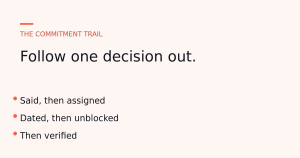
Ask for a smaller amount tied to a claim someone else can check, and you are more likely to get a decision than if you ask for the full year at once.
That sounds like a negotiating trick. It is closer to the opposite. A number invites an argument about the number, and the person you are asking has more practice at that argument than you do. A claim invites a decision about the work.
The demo that was not ready for a budget
What follows is a labelled hypothetical, written for this article. A distribution business builds a controlled demonstration: an AI step that reads supplier invoices and matches them to purchase orders. The person who built it demonstrates it in a management meeting on thirty invoices. It matches twenty-eight. The room is impressed and asks what it would cost to roll out.
The honest answer is that no one can say yet, and the reason is worth being precise about. Twenty-eight out of thirty is a result about thirty invoices chosen by the person demonstrating. It says little about the invoices that arrive as photographs of paper, or from the two suppliers whose reference formats changed last year, or during the week when volume triples.
A demo shows that something can work. A budget request has to say what happens when it runs unattended, and those are separate claims. The demonstration has earned the first one and has yet to attempt the second.
What finance is actually refusing
Take the request to the finance director and the reception is familiar: interest, then questions, then a suggestion to revisit it next quarter.
It is tempting to read that as caution about AI. Usually it is caution about an unbounded commitment, which is the job. A twelve-month figure for something that has run for three weeks asks the business to accept a year of exposure on the strength of a demonstration, and to accept it in one decision that becomes awkward to reverse in month four.
Staging changes what is being asked. One large irreversible decision becomes several small reversible ones. The reversibility is the product here.
A finance director who can stop at the next checkpoint is being asked to approve something fundamentally different from a full year of exposure.
The Second Cheque
The useful discipline is to write the request so the second payment depends on something checkable, and to state that something as a single sentence.
Not a summary, and not a set of objectives. One claim, specific enough to be checked. A person who dislikes your project should be able to look at the evidence in twelve weeks and say plainly that it failed.
For the distribution business, the first cheque covers twelve weeks of running the invoice step on one supplier group, and the sentence attached to it reads:
By 31 March, at least four in five invoices received from our top twenty suppliers will be matched to purchase orders without anyone opening them, while incorrect matches remain at or below the agreed baseline. The result will be measured across every invoice received, not a selected sample.
Four in five is illustrative, not a universal benchmark. The real threshold should be agreed from the current baseline, the cost of an error and the level of performance required to make the workflow worthwhile.
That sentence does several things at once. It names a population, so the difficult invoices are inside it too. It names a threshold, so a result that merely sounds promising still has a bar to clear. It names a date. And it names what counts as the work being done — matched without a person opening them — and not a proxy like accuracy, which stays high while somebody checks every line by hand.
The second cheque is released against that sentence. If the claim holds, the next tranche extends the supplier group and carries its own sentence. If it fails, the business has spent twelve weeks of one workflow and knows something it could not have learned from a longer demo.
The costs that hide in the handoffs
A first live tranche also exposes information that a controlled demonstration cannot, because the workflow now has to survive ordinary people, ordinary exceptions and the process around it.
In the distribution business the invoice step turned out to need a rule for credit notes, which had gone unmentioned because credit notes are handled by a different person on a different day. It also produced a queue of unmatched invoices for somebody to work through each morning. That somebody was the accounts clerk, who had not been consulted and whose morning already had a shape.
Neither of these is a failure of the tool. They are the ordinary friction of putting a step into a process that already exists, and they surface in the first month of real running or in the sixth month of a full rollout. The choice of which is what a staged budget is buying.
Adoption is the evidence, and it can go the other way
Twelve weeks in, the clerk is using the matched output for the top twenty suppliers and has stopped opening invoices that the system matched confidently. The agreed quality check remains within its limit. That is the claim holding: the workflow changed what a person does without moving the risk somewhere less visible.
The opposite result is equally informative and much easier to talk about when it was named in advance. Had the clerk kept opening every invoice to check, the correct reading would be that the step produced output the team distrusted, and the appropriate response would be to stop, rather than to fund a wider rollout in the hope that trust follows scale.
This is why the sentence attached to the first cheque has to be falsifiable. A claim that only ever comes back positive is a description of enthusiasm. A claim capable of failing, measured against the full population and its agreed quality boundary, becomes evidence when it holds.
The objection you should expect, and should take seriously
Someone will point out that twelve weeks of one supplier group proves little about the whole ledger, and they are right.
The staged request makes no such claim. It claims that one workflow, running unattended on a defined population, hit a stated threshold — and that this is a better basis for the next decision than a demonstration on thirty chosen invoices. Each cheque buys a slightly wider claim, and the business stays one checkpoint away from stopping.
The alternative on offer is usually a year of funding justified by a demo, which is a larger bet dressed as a plan.
Write the sentence before the meeting
Before you ask for anything, write the sentence that the next payment depends on. Give it a population, a threshold, a date, and a measure that describes the work being done, not a proxy for it.
Then show it to the person most likely to be sceptical, and ask them a single question: if this turned out to be false, would you be able to tell? If they hesitate, the sentence is still doing public relations, and you have found that out for free, before the checkpoint.
A request built this way is smaller, reversible and easier to decide. It gives the approver a testable next step instead of asking them to fund a forecast. Choosing which workflow to put the first cheque behind is what the diagnostic settles in writing.
Ready to make your AI actually reliable?
Book a diagnosis and we will map the highest-leverage fixes for your business.
Book a diagnosisSharper signal. Smarter decisions.
Join our newsletter for our best thinking on AI and systems, delivered straight to your inbox - no noise.