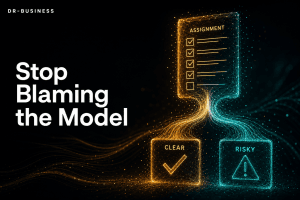
Assign each recurring AI task to a model based on what a wrong answer costs you. Write the rule down where someone else can read it. Re-test when the work changes. That habit will outlast every model release this year, and it takes an afternoon to install.
Leaderboards are downstream of this. They can tell you which model performed well on someone else’s benchmark. Your refund queue has its own benchmark, and you are the only person holding it.
One default model quietly concentrates every risk you have
Most teams settle on a single model because it removes a decision, and for a quarter or two that feels like maturity. Underneath, four different jobs are now running on one set of characteristics: support drafting, the weekly research memo, the classifier that routes inbound mail, and the code review assistant.
They were one decision wearing four names.
And the four want different things. The classifier needs a stable output shape at cheap volume. The code assistant needs scope control. The research memo needs a route tested for how it behaves when the evidence runs thin. Support needs one that recognises a case it should hand to a person. One route applies the same model characteristics to four jobs with different requirements, and different consequences when the output is wrong.
Prices move. Capabilities move. A route chosen in March can be a worse fit by September. So the durable question is which model is good enough for this task, asked again whenever the task or the model changes.
Routing is task assignment
Routing means deciding which model handles which job before anyone writes a prompt. Start it as a line in a shared document. Automate it later, once the rule has been boring for a month.
A workable policy answers four questions:
- What is the task? Draft, classify, summarise, research, code, compare, extract, respond or decide.
- What does a wrong answer cost? A weak subject line costs a rewrite. A misread refund policy costs a customer.
- How will quality be judged? Someone has to be able to describe a good answer before you can trust a machine to produce one.
- Which constraints bind? Latency, cost, privacy, access control, review capacity.
Here is the part teams underrate. Routing is an operating decision that a developer implements. Marketing owns the copy routes. Engineering owns the coding routes. Support owns the customer-response routes. A developer can build the switch in a morning; deciding when it moves takes longer and matters more.
The Model Route Card
Use this when you are choosing a model for work that repeats. Score each factor from 1 to 5. Some factors are gates, so resist the urge to average.
- Task risk. At 4 or 5, a person approves before anything leaves the building.
- Evidence requirement. If the job needs factual precision, drop any model that invented a detail during testing. One invented figure in a pilot predicts fifty in production.
- Eval confidence. Can your team reliably tell a good answer from a plausible one? Where the answer is no, keep the model on drafting duty.
- Output stability. Does it return the same shape across repeated runs? Automation depends on this far more than on eloquence.
- Latency fit. A live chat assist and a Monday research memo have different clocks.
- Behaviour consistency. Does it follow the instruction the same way across repeated runs, including when the input is messy or the evidence is thin? A model that holds the brief on clean inputs and improvises on hard ones is a poor route for work that arrives unsorted.
- Cost fit. Worth it at this volume, judged after the quality and risk gates. A cheap wrong answer bills you twice: once for the tokens, once for the person who fixes it.
- Data sensitivity. Customer records, private code, contracts, financials. Strip the fields the task can do without, and follow policy before anything private leaves your systems.
- Review path. Name the approver. An unnamed reviewer is an absent one.
The decision rule: take the cheapest, fastest model that clears the quality, privacy and review gates for that task. On high-risk work, eval confidence and review path outrank cost every time.
What you produce is one line per workflow. Invented here for an example team, it reads like this. Support classification runs on the lower-cost model, which matched our policy labels on 94 of 100 test tickets. Reply drafting runs on the stronger model with the approved policy set supplied. Sending stays with an agent. Three sentences, and the argument is settled until something changes.
Four task classes, four different gates
The same card produces different answers depending on the work. These four cover most of what a business actually runs.
Copy and content
Tolerant of variance, unforgiving on unsupported claims. Gate on evidence discipline. A model that writes a gorgeous paragraph and invents a market-share figure has failed this class, however good the paragraph was.
Coding
Gate on scope control and output stability. The expensive part is review time. A patch that fixes your bug and quietly reformats two unrelated files costs more than a slower model that stays inside the brief.
Research and synthesis
Gate on source discipline. The model has to separate what a document says from what it infers, and say so when the sources fall silent. Fluency is a hazard here, because a confident summary of nothing reads exactly like a confident summary of something.
Customer support
Gate on escalation behaviour. The model you want is the one that recognises a case it should hand over. Smooth handling of a refund edge case it misread is the worst outcome available, because it looks like success until the customer replies.
A support queue, routed two ways
Before: every ticket goes to one model, which classifies it, drafts the reply and proposes the resolution. Classification tolerates variance. A misread refund policy reaches a customer. Both run under the same settings anyway, so when a customer receives a confident wrong answer, working out which step produced it takes a reconstruction — one model performed all three.
After: classification runs on the cheaper model that matched policy labels in testing. Drafting runs on the stronger model with the current policy set attached. An agent sends.
Same tools, same budget. Each step now has its own quality bar and its own named reviewer, so a wrong answer points at the step that produced it.
“Should we just use the strongest model everywhere?”
Sometimes you should. A small team, low volume, everything reviewed by a person before it leaves: standardise on one strong model and skip the overhead. That is a reasonable answer and plenty of good businesses run it.
It stops being reasonable at three thresholds. When volume rises far enough that cost per accepted result starts to matter. When a workflow begins taking actions on its own conclusions. When two classes of work need different things from the model and one of them is quietly losing. Cross any of those and “use the best model” becomes a preference standing in for a decision.
What to do this week
- List the AI tasks that repeat, and group them into stable classes.
- Write the risk level and the named approver beside each class.
- Build a small evaluation set from real inputs, including the messy ones you would rather forget.
- Run two candidate models over identical inputs under the same review rule.
- Write one routing line per workflow, and the reason for it beneath.
- Re-test when the task changes, the sources change, or review time starts creeping up.
Questions teams ask
How many models should a small team test?
Two. Testing one model tells you whether it works; testing two tells you which one fits this class of work. Beyond that you have a routing layer only its author understands, which becomes its own failure mode around the time the person who built it goes on leave.
Should routing be automated?
Once the manual rule has been stable long enough to feel dull. Automating a rule you are still arguing about hard-codes the argument, and arguments are harder to debug than code.
What if the cheaper model is almost as good?
Then it belongs in the classes where the gates tolerate variance, and it stays out of the ones where they hold firm. “Almost as good” describes an average. Your gates exist for the worst case, which is the one that reaches a customer.
How often should routes be reviewed?
Quarterly for stable work, immediately when a provider changes pricing or capability. Put the review in a calendar, because the failure mode here is drift, and drift is silent.
Before you bolt on another tool, it is worth knowing whether your business runs on systems or on you. I put together a free 2-minute assessment that gives you a straight read on exactly that, and the first thing to fix. Take the free assessment.
Not sure where to start?
The free System Fit Check: nine questions in about five minutes that suggest one system to start with, and a free next step.
Start the Free Fit CheckSharper signal. Smarter decisions.
Join our newsletter for our best thinking on AI and systems, delivered straight to your inbox - no noise.